
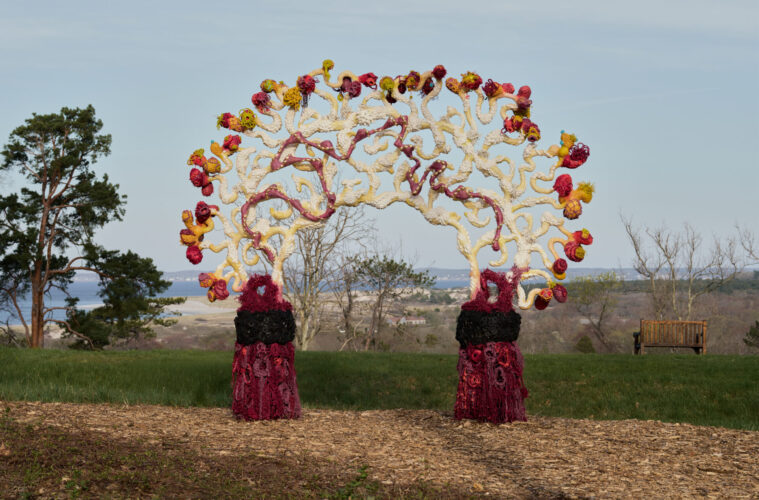
It’s hard to find the words to describe sculptor Posey Moulton’s new installation at the Crane Estate.
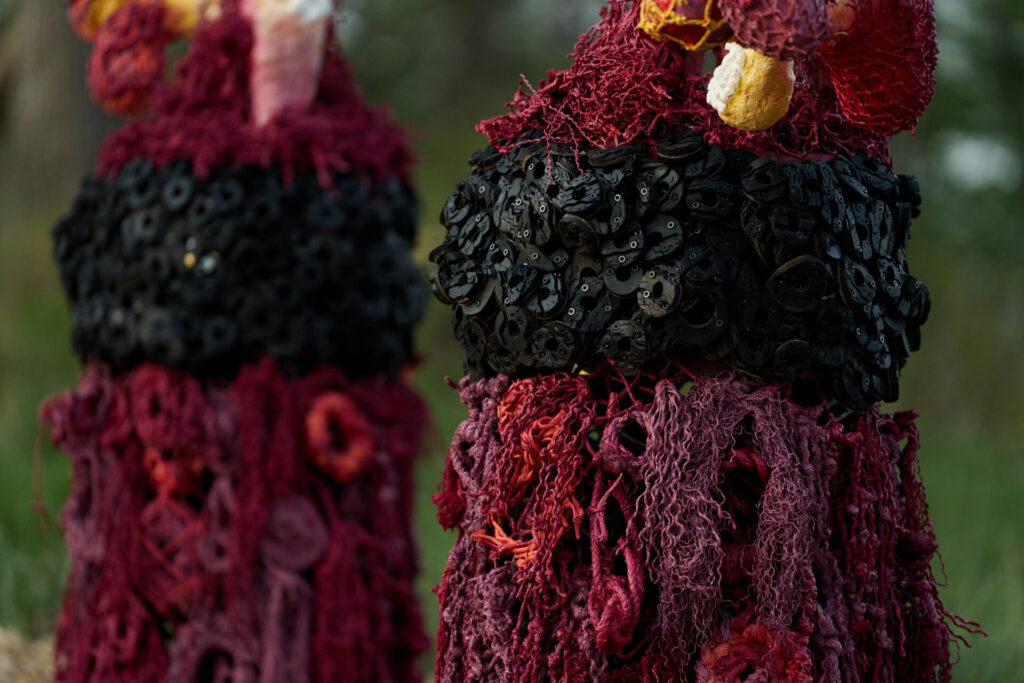
It is shaped like an arch, or perhaps a portal. The opening is crowned with a tangle — a filigree? — of organic white branches, each terminating in a swell of yellow or pink or earthy maroon. The legs that support the span are shaggy with a pelt of deep red rope strands. It feels decidedly like something wild, both natural and somehow otherworldly.
“I wanted it to feel alive, like a creature crawling from the earth,” says Moulton, as she puts the final touches on the piece on a blustery April afternoon. “It’s like a living being for me.”


Multi-Location Exhibition
The installation is part of a multi-location exhibition, “The Land Tells Our Stories,” organized by the Trustees of Reservations. Artists were commissioned to create site-specific works at each of three of the organization’s properties: the Crane Estate, Moose Hill Farm in Sharon, and Rock House Reservation in West Brookfield. Artists May Babcock, and Ella Mahoney are working at the other two sites.
The idea behind the initiative is to explore and engage with landscapes of cultural, historic, and environmental importance, inviting visitors to look at these inspiring places in new ways, says Tess Lukey, associate curator of Native American art for the Trustees. “It’s about uplifting our special places and the stories that are deeply situated in them,” she says. “Art and environment uplift each other.”
Lukey began thinking about creating the exhibition about a year and a half ago. She came across Moulton’s work early in her research and reached out; the two immediately clicked. They got together and toured Trustees properties around the North Shore, looking for the spot that fired up Moulton’s creativity.
The site they landed on is a patch of land tucked away off the rolling lawn that connects the great house atop Castle Hill to the beach below. Moulton likes the way the spot offers views of the sprawling Great Marsh, as well as the magnificent architecture of the property.
Artistic Process
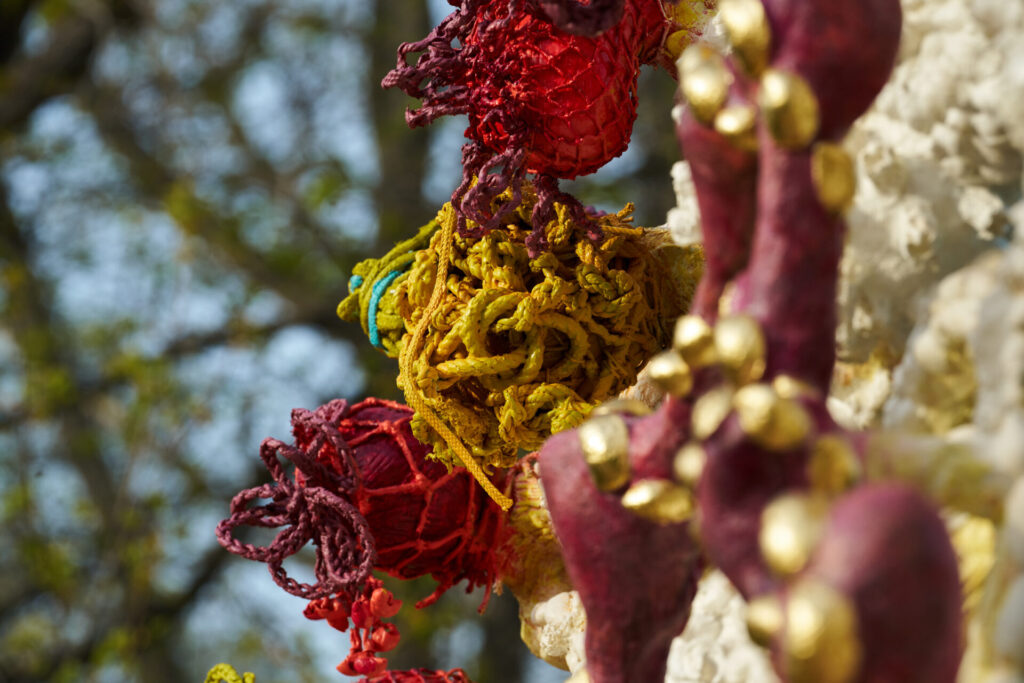
Moulton did extensive research into the location’s ecosystem as she created her piece, dubbed “Second Wind.” She learned that the marsh is in danger of drowning under rising sea levels caused by climate change, an idea that got her thinking about the act of breathing: The colorful shapes around the edges of the sculpture represent alveoli, the sacs where oxygen is exchanged in human lungs.
“It’s kind of like breathing life back into the marsh,” she says. “This is like the pulsing of some part of our body.”
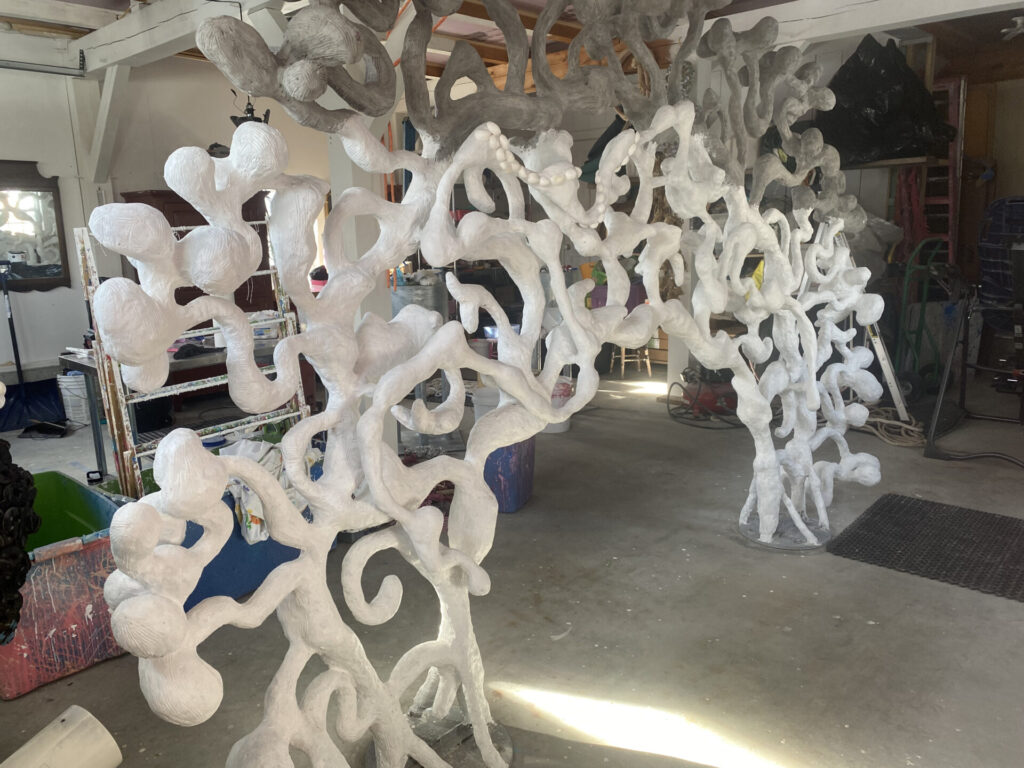
The immediate landscape inspired many details of the piece. A close look at the white branches reveals hundreds of shells. Many were cast in the shape of shells Moulton collected on Crane Beach, though some are the artist’s own creation, a merging of imagination and landscape. A purpley pink segment that undulates across the white mimics the course of a creek that runs through the marsh, as seen from above.
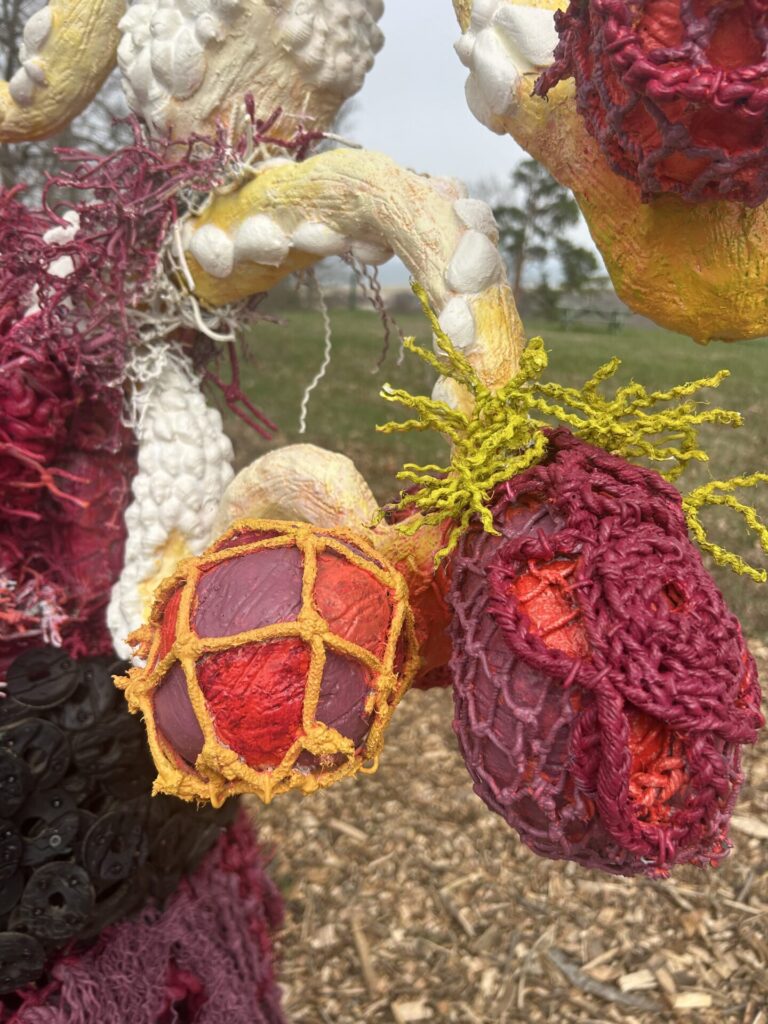
Other materials come directly from the surroundings. The colorful roping that coils around and hands from the piece all comes from salvaged fishing nets. The black plastic discs that ring the sculpture’s legs are rockhoppers, which are used to weight fishing nets dragged along the ocean floor. In the water, they damage aquatic ecosystems; here they are repurposed in service of art.
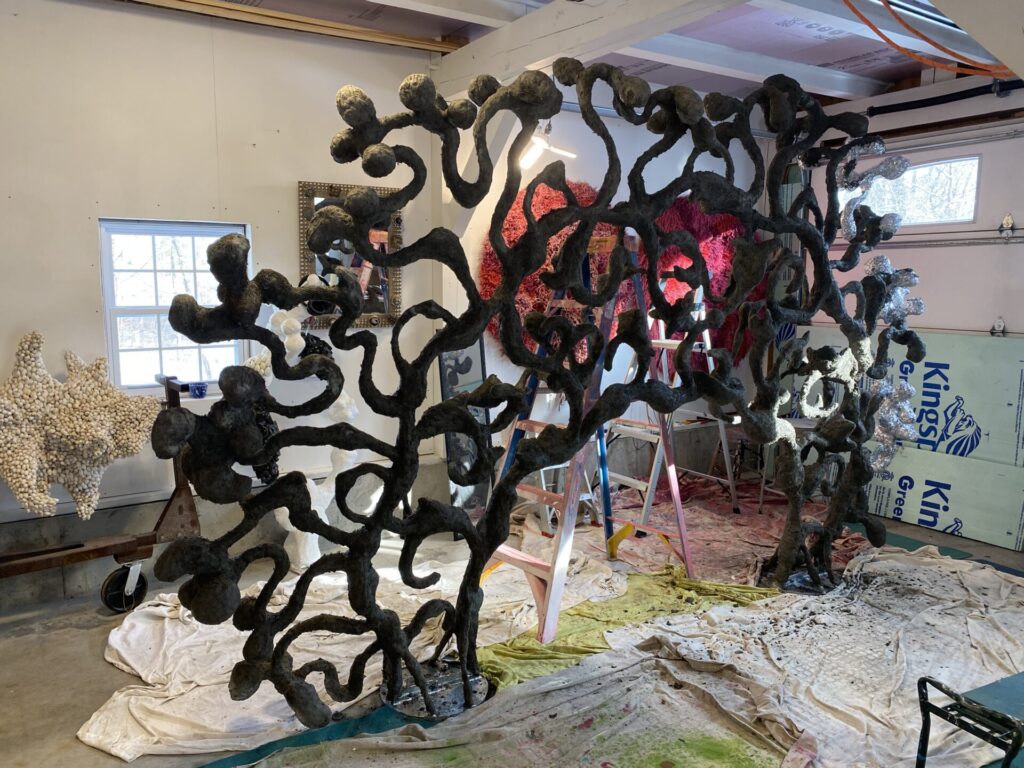
Moulton built most of the piece at her studio in Maine, working 12-hour days from November until it was time to transport and assemble the work in Ipswich. “I’ve been obsessed,” she says. “I’ve really loved working on it.”

The full exhibition launched June 1 and ran through the end of October. Second Wind, however, will remain on the estate for more than a year, offering many opportunities for visitors to run their hands over the piece, catch a sunset framed by the art, and step through the archway.
“I’m really into making joyful art,” Moulton says. “It’s a portal to a better place, maybe.”
For more information: thetrustees.org/content/moulton-second-wind