This summer, a lineup of iconic American paintings comes to Salem for the first time. The Peabody Essex Museum (PEM) hosts a traveling exhibit called Making History: 200 Years of American Art, carrying with it some of the most famous works from the Pennsylvania Academy of the Fine Arts (PAFA).
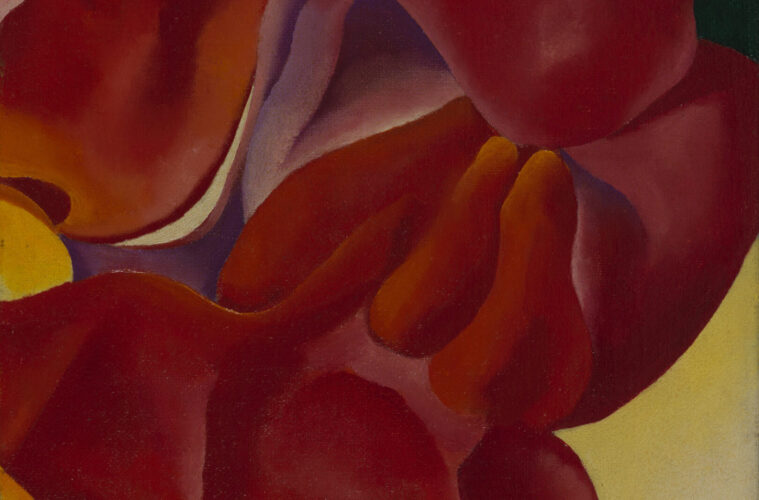
Want to see works like Georgia O’Keeffe’s Red Canna, Gilbert Stuart’s George Washington (The Lansdowne Portrait), or Stuart Davis’s Ultra-Marine in person? Then head to the PEM now through September 21.
The Making History exhibit, which opened at PEM on June 14, includes 85 works from PAFA’s collection, all of which were created between 1776 and 1976—from the year the United States declared independence from Great Britain until 200 years later. By 1976, the country had experienced countless watershed events—a Civil War, a depression, brisk expansion onto Native lands, two World Wars, and a landmark civil rights movement—all of which shaped what it meant to be American. And to make American art.

“[American art] has been debated since the 1940s, when the field of American art came into existence. There was this effort to try to understand what makes American art distinct, especially from European art,” says Jeffrey Richmond-Moll, Ph.D., PEM’s George Putnam curator of American Art and the organizing curator of this exhibition at PEM.
Richmond-Moll explains this “sort of inferiority complex that, I think, Americans had about creating a sense of our own homegrown and self-made canon of painting and sculpture that was connected with the ideals of American society and American history,” he says, and distinct from the art made in other countries.
The existence of American art as a category is undeniable. Think of Edward Hopper’s Nighthawk, casting light on folks in a downtown diner on a deserted urban street corner, or the stern looks of Midwesterners in American Gothic. Think of Andy Warhol, Jean-Michel Basquiat, Norman Rockwell, John Singer Sargent. This traveling exhibit at PEM aims to tell the story of the evolution of our national artistic identity. What makes American art American, and how has that changed over time?

American History
“Making History is about the role of artists in sharing and reframing our understanding of the United States, of American history, of American identity,” says Richmond-Moll, “and really the way that art is used as a visual tool for helping us understand our past, present, and future in this place.” He uses one of the exhibit’s most prominent works as an example to “show how art has continued to be a tool for artists to try to capture a sense of American culture and identity.”
Gilbert Stuart’s Lansdowne portrait of George Washington is one of the most famous depictions of the first U.S. president, likely showing an address he gave to Congress on December 7, 1795. Washington is wearing a simple black coat, his arm outstretched. A rainbow in the corner symbolizes peace and prosperity, but Washington disagreed with his cabinet over English relations at the time. Stuart emulated European aristocratic portraiture in his style, showing Washington in front of a background of red velvet upholstery with a quill and paper on the table behind him. It’s Stuart’s iconic portraits of Washington that have shaped how Americans, even 250 years later, regard the first president.
Now think of American presidential portraits “as opposed to the portraits of King George, where you have this aristocratic sense of a king who has inherited his throne,” says Richmond-Moll. “An American president looks very different from a British king, so how do we formulate a visual language of American identity? This is something that artists have long tried to figure out.”

Embracing Diversity
The exhibition also embraces stories of American women and LGBTQ+ artists. It’s organized into thematic sections—portraiture, history painting, still life, genre scenes, and landscape—so works from different time periods sit side by side, inviting comparison. Charles Willson Peale’s George Washington at Princeton (1779) hangs beside James Brantley’s contemporary realist Brother James (1968), asking how what it meant to be an American artist changed over the course of 200 years.
You’ll also see works by Sarah Miriam Peale, Mary Cassatt, Cecilia Beaux, Alice Neel, and May Howard Jackson, some of the first women to exhibit with PAFA, along with Henry O. Tanner’s Nicodemus (1899), PAFA’s first work by a Black American artist.
“This exhibition is a wonderful experience for PEM’s audiences because there are just so many incredible works of American art, of paintings and sculpture that aren’t represented within our collections,” says Richmond-Moll. “Icons of American art that really don’t ever leave PAFA’s buildings are traveling as part of the exhibition.”
North Shore Roots
Some of those works have deep North Shore roots. You’ll see Winslow Homer’s Fox Hunt (1893) and Edward Hopper’s Apartment Houses (1923). Both artists spent significant time working in Gloucester’s Rocky Neck, a longtime artist colony.

“As institutions that were founded so soon after the foundation of the United States, both PEM and PAFA were trying to feel their way through a sense of what it means to display art and artifacts to a new American public,” explains Richmond-Moll of this exhibit’s significance in Salem. “They both reflect this self-awareness and self-conscious impulse to capture a sense of history being made in the present.”
PEM is Making History’s second to last stop on its nationwide tour that began at the Wichita Art Museum on January 28, 2024. The exhibit also had runs in Albuquerque, Tulsa, and Syracuse, and it’ll visit Roanoke, Virginia, before closing early next year. “Then and now,” says Richmond-Moll of the exhibit’s 200-year span, “what makes art American is this commitment to reckoning with democratic ideals, with notions of liberty, equality, and diversity.”

