

Since Stages – an exclusive six-seat chef’s counter restaurant—opened in March 2012, chef Evan Hennessey has dazzled diners with his molecular spin on ingredients foraged and cultivated around New Hampshire’s Seacoast— from reindeer moss to kelp, dulse to sea truffle. After finding success in bigger cities, the Dover native saw opportunities to embed in his hometown and cook from its terroir. “I appreciate a small-town feel,” Hennessey says. “There’s a lot more connectedness.”
Working within the scope of community-minded food, the three-time Chopped champion steps into a different role four times every year. In November 2023, Hennessey launched a staging program in which he mentors chefs from across the country as they craft a three course tasting menu.
Staging programs are designed for chefs to learn at another restaurant’s kitchen, and foodies and fans of The Bear alike can get a peek inside at Stages. Guests are seated around the cozy, well-appointed Living Room, and the featured chef talks diners through each of the evening’s courses. While some armchair epicures may be familiar with inventive tasting menus, the stage is a more interactive experience. Between courses, the chef returns to the dining room, and Hennessey encourages diners to share honest feedback.
“For the chefs, this is about understanding their cooking better and how to connect with the people they’re cooking for,” says Hennessey. “For diners, it’s an opportunity to open the curtain, see how we got to this point, and get a peek into the learning process for the next generation of cooks coming through.”
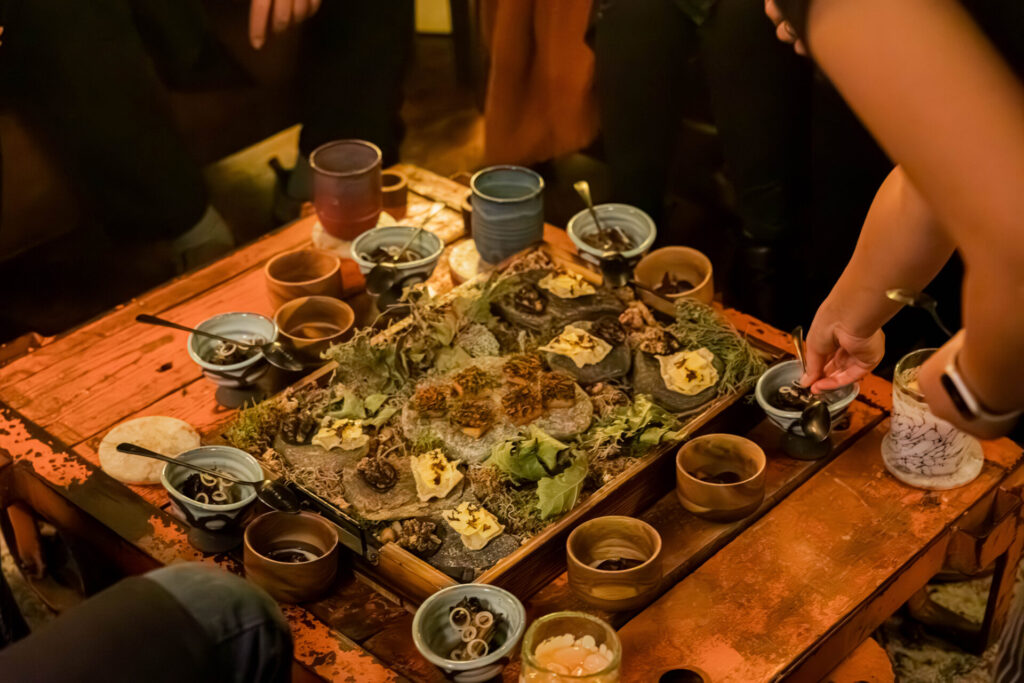
Going under the microscope proved highly instructive for Jake Vatalaro, who was working as a sous chef at a restaurant in Boston in November 2024 when he completed his stage. Partnering with Hennessey, he realized how important presentation is to the guest experience. For an amuse bouche, Vatalaro served a venison tartare in a nori tartlet as a riff on surf and turf, and he found himself searching in the kitchen for the right touch.
“Chef Evan had these trays that are filled with moss, leaves, and rocks from the shore,” says Vatalaro. “We put the amuse on the rocks and decorated the plate with leaves, ‘bringing the land to the sea,’ as Chef Evan described it.” While plating was an eye-opening and creative aspect of the stage, Vatalaro paid careful attention to every last ingredient. Developing the menu with Hennessey’s mentorship introduced him to an entirely new library of techniques.
“For basically every course, he showed me something new that either made the preparation way easier or tied the dish together completely,” Vatalaro says. His main course consisted of monkfish poached in verjus and persimmon juice dressed up in a squid ink emulsion. Before plating it, Hennessey had the idea to emulsify the poaching liquid in a Vitamix with xanthan gum until it became a thick foam.
“This was a little stroke of genius that I think really completed the dish,” says Vatalaro. While the stage provides emerging chefs with an opportunity to test out their menus, it also allows diners to encounter flavors they might not usually find at the restaurant.
As a sous chef at Stages, Yundi Li watched other visiting chefs achieve an almost palpable joy as they completed the program. When she had the opportunity to participate, she developed an incredibly personal menu. Her grandmother, who had a major role in Li’s upbringing, had recently died. Almost all of the chef’s childhood memories of food revolved around her.

“I kept trying to find a way to feel the connection to my grandmother again, and cooking is, of course, one of the biggest ways for me to do that,” Li says. “I studied how to use ancient Chinese cooking techniques without losing how we represent New England.”
Keeping with Stages’ local ethos, Li dove into regional Chinese dishes and experimented with how she could replicate these recipes the New England way. For an amuse bouche, she pan-fried tofu with truffles and black garlic, but because soy beans don’t grow in New Hampshire, she made her own with lentils. One of the night’s standouts was inspired by bamboo-tube cooked rice and meat from Southern China. Pulling it off required that Li follow in Hennessey’s foraging footsteps. “Instead of bamboo, I used white birch bark, because the birch tree is New Hampshire’s state tree, and it has a very nice aroma,” says Li.
For a year, she collected white birch bark in a backpack, which she used to smoke a branzino. Birch bark is highly flammable, however, so she wrapped it in rehydrated kombu, which deepened the flavor profile. Reflecting upon the experience, Li sees that the stage became a meaningful tribute to her grandmother’s legacy. “It gave me a chance to really dig deep about my story— who am I, what do I stand for, what does it mean that my grandmother affected my cooking, and what does it mean to combine my background with New England’s local ingredients,”.